

- This event has passed.
Adeline Hotel and Cameron Knowler
July 19 @ 4:00 pm - 6:00 pm
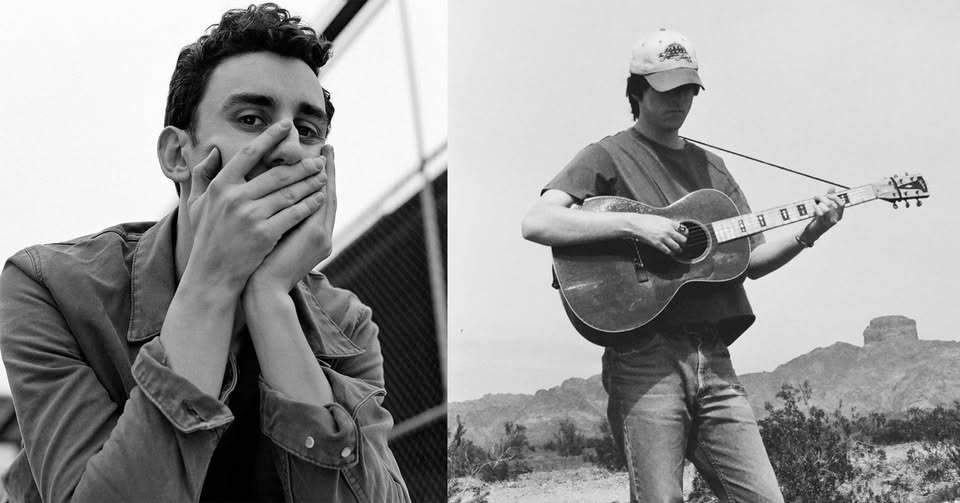
Adeline Hotel (USA)
Pitchfork-endorsed alt indie folk / country from New York in a Neil Young / Jim O’Rourke vein as seen with Brigid Mae Power and William Tyler
https://adelinehotel.bandcamp.com/
Pitchfork-endorsed alt indie folk / country from New York in a Neil Young / Jim O’Rourke vein as seen with Brigid Mae Power and William Tyler
https://adelinehotel.bandcamp.com/
Cameron Knowler (USA)
Instrumental fingerpicked acoustic guitar from Arizona offering postmodern perspectives on American traditional music
https://cameronknowler.bandcamp.com/
Instrumental fingerpicked acoustic guitar from Arizona offering postmodern perspectives on American traditional music
https://cameronknowler.bandcamp.com/
FREE ENTRY with donations for acts gratefully accepted
—— Further Info ——
“What I’m going through is hard to describe,” Dan Knishkowy sings near the end of his kaleidoscopic new album, Watch the Sunflowers. Recording as Adeline Hotel, the songwriter, guitarist, and Ruination Record Co. label head has made an art of complicated feelings, whether zooming in so closely that he can describe each individual thread or panning out until the view becomes psychedelic and strange. At a prolific pace, he has accompanied these observations with music that’s just as creatively restless. On one record, he is a solo guitarist improvising in a quiet room; on the next, he’s a piano balladeer backed by strings. He may front a rock band that draws inspiration from Neil Young at his most ragged and Richard Thompson at his most stately; on another, he may blend into the autumnal hush of a complex jazz group.
The expertly written, masterfully delivered Watch the Sunflowers is the most colorful music of Knishkowy’s career. This, of course, is a direct response to what came before it. These seven imagistic songs arrive after 2024’s breakthrough Whodunnit, a record whose stark portraits of codependency and isolation were delivered as raw and nakedly as Knishkowy ever allowed himself. If those songs seemed to burst forward on the immediacy of their feelings, this time, he compares his approach to a Richard Linklater film. This process encouraged him to live inside the stories and notice how the passing of time changed the atmosphere, whether that meant embellishing the compositions with lush, expansive arrangements or sanding them down to impressionistic loops.
Produced with Nate Mendelsohn and bandmate Winston Cook-Wilson, the music arrives in a lineage of rock bands pushing their sounds to the brink. I think of the rock-bottom alien transmissions on Wilco’s A Ghost Is Born or the downer anthems of Big Star’s Third: albums where traditional rock bands presented their most fragile material in rooms where everything seemed to be falling apart. The recording process proceeded in two distinct phases. First was a traditional session in 2022 with regular collaborators Andrew Stocker on bass, Sean Mullins on drums, and Cook-Wilson on keys. After sitting on the material and letting the songs shapeshift in his mind, Knishkowy revisited them in early 2025 with Mendelsohn and Cook-Wilson, whom Knishkowy also enlisted to provide the sweeping string arrangements.
In response, Knishkowy found himself revising the lyrics and updating the music to suit his evolving perspective. Sometimes, as in the hypnotic “Just Like You,” the distance allowed him to reimagine once again what Adeline Hotel could sound like. By the time they arrived at the album version, Mendelsohn was creating warped layers of processed effects; Cook-Wilson tapped out rhythms on a drum machine; Jackie West provided comforting vocal harmonies that drift through the knotty arrangement like falling leaves; Knishkowy built a loop from electric guitar that became the backbone of the track. Other times, as with the epic title track, he looked back at lyrics he had written nearly a decade earlier and reconvened with his younger self.
Where this process might lead some songwriters to seek resolution, it only encouraged Knishkowy to ask more questions. In fact, there has never been more searching on an Adeline Hotel record. Am I dreaming? Am I living? Did I grieve enough? Where will I begin? By now, we are accustomed to turning to Knishkowy’s lyrics for stability amid prolonged stretches of turbulence. But on Watch the Sunflowers, he seems less interested in summoning wisdom than simply enduring. Plenty of images across the record bring this feeling to life—the “holy visions” in “Dreaming,” his “eyes open wide while swimming” in “Swimming,” the struggle to find stability in creative fields that recurs like a creeping anxiety. Across the songs, Knishkowy quotes sources ranging from Maggie Nelson’s Bluets (“Wondering if there was good kinds of hustlers”) to Cass McCombs (“I’m nobody’s puppy, nobody’s dog.”), all in the spirit of buttressing a narrator in suspended freefall.
As is often the case with Adeline Hotel, the vision is fully realized with the enrapturing sound of the music: another distinct entry in a discography that is growing more complex and textured with each new entry. Knishkowy has situated this record in part of an interconnected, time-jumping trilogy that includes the climactic Whodunnit and a more resolved record to follow. This in-between state puts these songs—vivid but ghostly, slow-forming yet urgent in their emotional character—in a strange place. And yet, few songwriters seem so poised to narrate from this bleary vantage. “Light illuminates the dust between our lives, some things take a little while,” he sings in the opening “Dreaming,” as if narrating his own creative process. “I was free again if only for a moment.” On Watch the Sunflowers, a moment is all it takes to see things clearly. — Sam Sodomsky
Adeline Hotel recently released, Watch The Sunflowers, This follows last year’s Whodunnit (which received acclaim from Pitchfork, Aquarium Drunkard, The Fader) and the instrumental records Hot Fruit, and previously Good Timing. He has opened for folks like Marlon Williams, Naima Back, Brigid Mae Power, and William Tyler.
——
An acclaimed educator, multi-instrumentalist, and recording artist, Cameron Knowler specializes in the art of the conceptual record, putting forth instrumental works that Folk Radio UK has referred to as “Western sound-painting.” His craft follows in the theoretical footsteps of instrumentalist and songwriter Norman Blake and expands upon that territorial folk convention: Knowler brandishes a post-modern perspective on American traditional music that nods to both his formal theory training and his roots in the American West.
Featuring contributions from Jordan Tice (of Hawktail), Jay Bellerose, Harrison Whitford, Rayna Gellert, Dylan Day, Mark Goldenberg, Rich Hinman and Robert Bowlin, CRK, a self-titled affair, finds Cameron Knowler at an exciting crossroads between American tradition and forward looking guitar soli – toeing the line between personal regionalism and the universality of landscape memory. CRK draws on the history and geography of Knowler’s birthplace of Yuma, Arizona- a border town known for its lettuce production and defunct territorial prison. In line with the regional ethos of the composer Frantz Casseus and the minimalism of Bruce Langhorne, this instrumental guitar record launches into a world of desert sun, propane tanks, dark jail cells, and the verdant Colorado. Knowler ferries listeners across a sensitively crafted world with deft, understated playing, pushing the current of instrumental acoustic music forward through lush original compositions, while keeping an eye on tradition with his singular arrangements of old time fiddle tunes. With what many describe as the closest thing to the right hand of Norman Blake, Knowler’s delivery also nods to the work of creative outsiders Terry Allen and David Rawlings.
With this work, Knowler sonically illuminates untold stories of the Sonoran, lending a voice to the pictorial canon made famous by Dorothea Lange and western films such as “3:10 to Yuma.” There is a sense of interiority to the record as well, Knowler says, noting that he “grew up isolated, unschooled in a desert with very little contact with children my own age.” He only returned to his hometown recently to revisit places held in memory, and CRK stands as a direct result of unpacking those landscapes coded with personal darkness. By creating an outward-facing work of art, Knowler strives to “make sandcastles out of grief” and emblazon the diorama of his youth.
With CRK, the world receives a sound poem, a memory palace that stands as a document of both personal grief and acceptance of the many dimensions of a place. We hear the sweeping landscapes of the Sonoran desert, and the darkness housed therein, even in The Sunniest Place on Earth.
“Pure musical expression pulling from over a hundred years of American folk history but still feels unburdened by the past and looks sharply towards the future of what the guitar can be. Everything you want from an instrumental guitar record is all here.”
– Hayden Pedigo
– Hayden Pedigo
“CRK! What a fantastic piece of hope medicine you released. Congratulations and great work! It’s fantastic and so inspiring.” — The Tallest Man on Earth
“Love the record. You’re doing something totally rooted in tradition but totally new.” — Matt Combs
“Cameron writes guitar music that sounds like it has always existed and was simply excavated from the fretboard. To me, that is the highest ideal of guitar tunecraft.” — Jordan Tice
“Such a beautiful record wholly yours and unlike anyone else.” — Joseph Terrell